Tag: Social Media Advertising

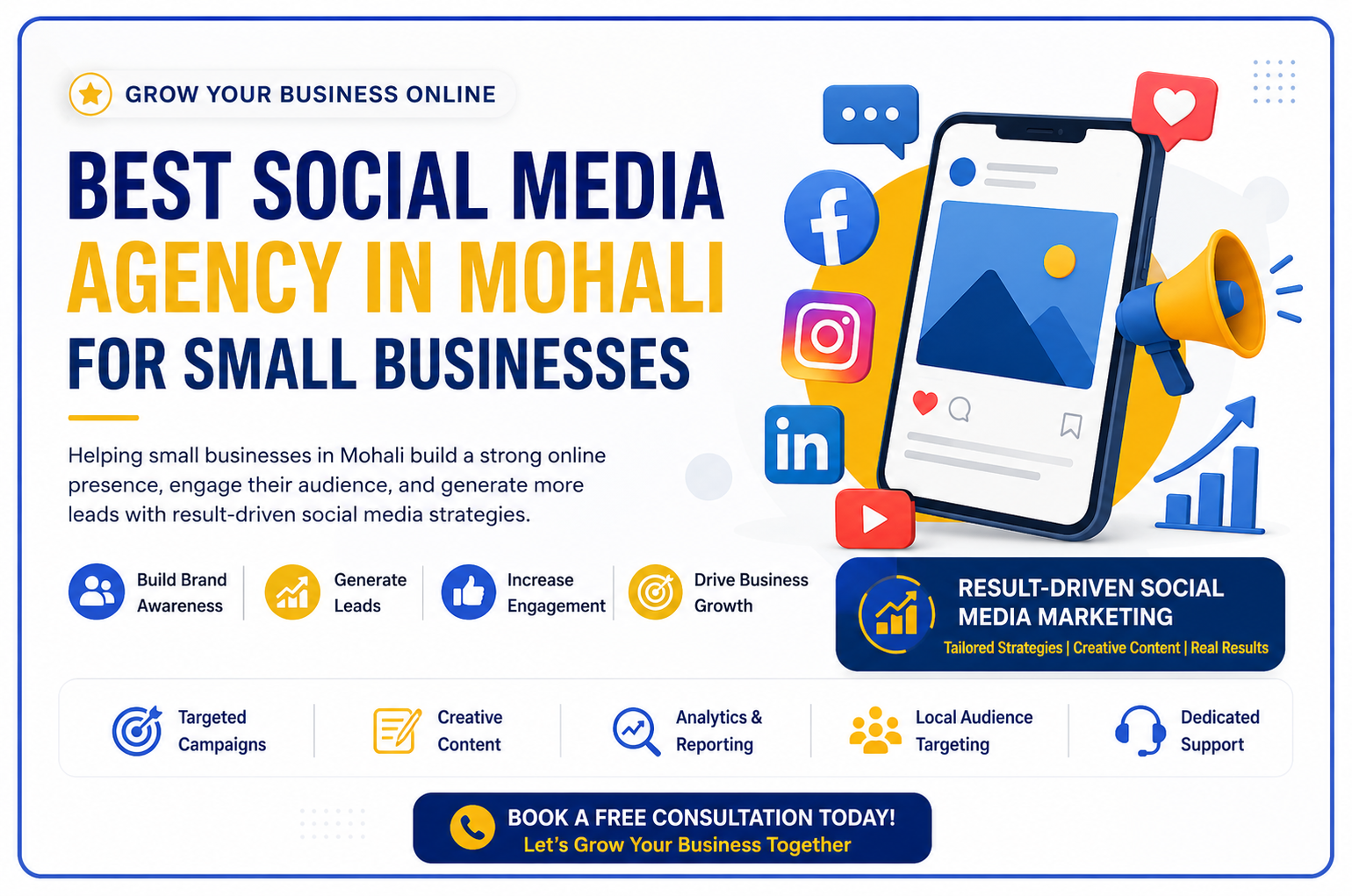
  • Best Social Media Agency in Mohali for Small Businesses: Scale Your Local Brand Exponentially

    Best Social Media Agency in Mohali for Small Businesses: Scale Your Local Brand Exponentially

    Best Social Media Agency in Mohali for Small Businesses: Scale Your Local Brand Exponentially

    Published on: June 25, 2026 | Category: Digital Marketing & Growth Strategy

    In today’s hyper-connected business landscape, establishing a robust digital footprint is no longer a luxury reserved exclusively for multinational corporations. For small and medium-sized enterprises (SMEs) operating in the bustling economic hub of the Tricity, high-impact digital branding has emerged as an absolute survival metric. Small businesses frequently find themselves competing with legacy brands that possess massive marketing budgets. However, the digital landscape democratizes this playing field. To successfully navigate this space, partnering with the Best Social Media Agency in Mohali is the most definitive strategic move a local business owner can make to amplify visibility, foster deep community engagement, and systematically acquire loyal clients.

    1. Why Social Media Matters for Small Businesses in Mohali

    Mohali (SAS Nagar) has evolved rapidly from a quiet residential suburb into a high-octane corporate, educational, and technological epicenter. As hundreds of new retail outlets, cafes, real estate consulting firms, tech startups, and healthcare clinics crop up across sectors like 70, 82, and the Phase areas, local visibility has become highly competitive. Relying strictly on traditional signage, flyers, or word-of-mouth is no longer sufficient to guarantee sustainable footfall or lead inquiries.

    Deploying professional social media marketing Mohali solutions offers localized businesses several unique strategic leverage points:

    • Hyper-Local Brand Awareness: Advanced demographic filters let you showcase your services specifically to active prospects residing or working within a 5-to-10-kilometer radius of your store or office.
    • Direct and Dynamic Customer Engagement: Social media transforms static advertising into a two-way conversation. It allows local businesses to address client inquiries, receive instantaneous feedback, and humanize their corporate brand via stories, polls, and direct messaging.
    • Continuous Lead Generation Opportunities: By running optimized interest-based campaigns, local service providers—ranging from fitness studios to boutique law practices—can collect high-intent inquiries from local clients systematically.

    2. What Makes the Best Social Media Agency in Mohali?

    While many generalist digital marketing agencies operate across Punjab, identifying the true industry leaders requires analyzing key operational capabilities. A top-tier agency doesn’t just promise arbitrary metrics like “likes” or “followers.” Instead, they build bespoke customer acquisition systems.

    When searching for the Best Social Media Agency in Mohali, look for these foundational agency traits:

    • Extensive Local Industry Experience: The agency must possess deep familiarity with the distinct socio-economic demographics and buying behaviors of residents across Mohali, Chandigarh, and Panchkula.
    • Highly Customized Strategies: Avoid cookie-cutter content plans. A premium agency conducts thorough competitor benchmarking and audits your specific business needs to craft a tailored growth roadmap.
    • Creative and Multimedia Asset Production: High-performing social campaigns require striking, custom-designed graphic layouts, professional short-form vertical reels, and compelling copywriting that matches your brand’s unique voice.
    • Data Transparency and Granular Reporting: Real leaders provide clear, accessible performance dashboards detailing key business metrics like conversion rates, cost per lead (CPL), and return on ad spend (ROAS).

    Operational Metric In-House / DIY Management Professional Agency Management
    Strategy & Planning Spontaneous, uncoordinated postings without clear target personas. Data-backed monthly calendars aligned with clear revenue goals.
    Content Quality Basic smartphone photos; minimal video editing capabilities. Studio-grade graphic layouts, trending Instagram reels, and custom copy.
    Ad Optimization Basic “Boost Post” clicks, resulting in high ad spend leakage. Advanced Meta Pixel tracking, A/B testing, and lookalike audience models.
    ROI Trackability Vague monitoring focused on vanity metrics (likes/comments). Monthly comprehensive audits tracking conversion costs and pipeline growth.

    3. Services Offered by a Top Social Media Agency

    A holistic digital marketing agency Mohali provides a comprehensive suite of organic and paid services tailored to guide prospective buyers smoothly through your marketing funnel:

    Comprehensive Social Media Management

    End-to-end multi-platform management keeps your digital channels active and professional. This service handles daily posting schedules, community monitoring, review management, and profile optimization, ensuring your profiles remain competitive around the clock.

    Multi-Platform Strategic Marketing (Facebook, Instagram, & LinkedIn)

    Different demographics require specific channels. Strategic Facebook Marketing Mohali initiatives help you reach family decision-makers and established demographics through community groups and geo-targeted ads. Concurrently, cutting-edge Instagram Marketing Mohali campaigns leverage high-quality visual content, vertical reels, and influencer partnerships to capture the attention of younger audiences. For B2B businesses, corporate service providers, and SaaS enterprises in Mohali’s IT hubs, specialized LinkedIn marketing establishes executive thought leadership and secures enterprise-level inquiries.

    Data-Driven Advertising & Lead Generation Campaigns

    Organic reach provides a solid foundation, but paid social media advertising scales revenue. By deploying advanced lead-capture forms, custom retargeting setups, and strategic lookalike audiences across Meta and LinkedIn networks, top agencies deliver consistent commercial inquiries directly to your sales team. This consistently lowers your average client acquisition costs.

    4. Benefits of Hiring a Local Social Media Agency

    While remote digital agencies can be found globally, partnering with a local agency based directly in the Tricity provides distinct operational advantages:

    • Intimate Knowledge of Local Culture: A local agency understands the nuances of the regional market, including seasonal shopping trends, local landmarks, and cultural preferences across Punjab. This allows them to create content that resonates deeply with local audiences.
    • Seamless Content Collaboration: Choosing an agency down the road makes it easy to coordinate on-site video shoots, capture real-time team photos, and host quick, in-person strategy alignments.
    • Agile Local Targeting: Local teams can rapidly design and launch real-time promotional campaigns centered around local festivals, regional events, or sudden market shifts, giving you a distinct competitive edge.

    5. Why Choose Us

    When it comes to executing flawless digital strategies, Social Media Agency Mohali stands out as a premier partner for growing small businesses. We balance creative excellence with rigorous data analysis to build sustainable digital growth engines.

    Small businesses and local service providers choose us as their trusted Digital Marketing Agency Mohali partner for several key reasons:

    • Unparalleled Technical Expertise: Our experienced team includes skilled copywriters, certified Meta advertising specialists, creative videographers, and data analysts who collaborate to maximize your brand’s digital performance.
    • Budget-Friendly Packages for SMEs: We recognize that small businesses operate with careful budget constraints. Our tiered pricing plans make premium digital marketing accessible, offering excellent value without compromising on quality or performance.
    • Focus on ROI-Driven Outcomes: We prioritize business results over surface-level metrics. Our primary goals are driving phone calls, boosting physical store traffic, capturing qualified web forms, and increasing overall revenue.

    6. Success Factors to Look for Before Hiring an Agency

    Before signing a long-term contract with any local marketing provider, verify their track record using these standard selection criteria:

    1. Examine Active Case Studies & Portfolios: Review their past work to assess the aesthetic and functional quality of their social media feeds. Look for demonstrated experience in your specific industry or niche.
    2. Read Local Client Testimonials: Check independent review platforms like Google Maps to read genuine feedback from local business owners who have partnered with them.
    3. Evaluate Communication Clearances: Ensure the agency assigns a dedicated account manager and establishes regular communication channels to keep your team aligned.

    7. Frequently Asked Questions (FAQ)

    Q1: How much does professional social media marketing in Mohali cost?

    Pricing varies based on your posting frequency, content requirements, and ad spend. Most professional agencies offer entry-level packages for small businesses starting around ₹12,000 to ₹25,000 per month.

    Q2: Which social media channels should my local small business prioritize?

    For standard retail brands, lifestyle products, hospitality spots, and medical practices, Instagram and Facebook are ideal. Professional service firms and B2B businesses typically see the highest returns on LinkedIn and Twitter.

    Q3: How long does it take to see measurable business results from social campaigns?

    Paid lead generation campaigns can generate inquiries within days of launching. Organic growth and brand building usually require 3 to 6 months of consistent, strategic posting to show significant returns.

    Q4: Does my monthly agency package fee cover social media advertising costs?

    No, the agency fee covers strategic planning, graphic design, content creation, and campaign management. Your advertising budget is paid directly to platforms like Meta or Google.

    Q5: How do we track the success and ROI of our social campaigns?

    We track performance through comprehensive monthly analytics reports. These reports detail key metrics, including conversion rates, cost-per-lead, link clicks, organic profile growth, and total ad-driven revenue.

    8. Conclusion: Ready to Scale Your Local Presence?

    Social media marketing is no longer just about gaining likes; it’s a vital engine for business growth. Consistently publishing high-quality content, running targeted local ads, and engaging with your audience helps you build long-term brand equity and keep your sales pipeline full.

    Claim Your Free Social Media Growth Consultation

    Partner with Social Media Agency Mohali today. Let our experts craft an ROI-driven marketing roadmap tailored to your business goals.

    Book Your Strategy Session Now

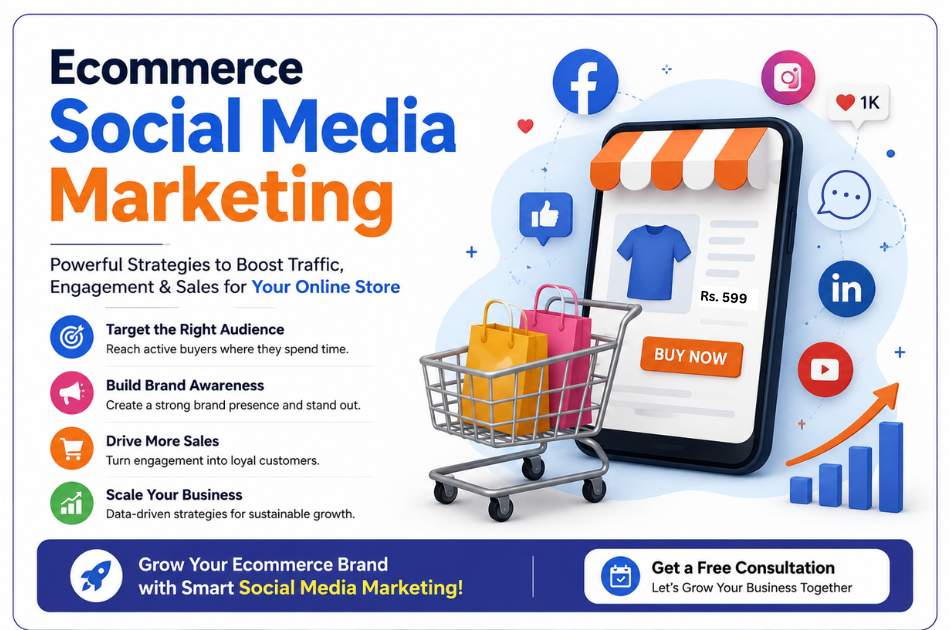
  • The Ultimate Guide to Ecommerce Social Media Marketing: Drive Traffic, Engagement, and Explosive Sales

    The Ultimate Guide to Ecommerce Social Media Marketing: Drive Traffic, Engagement, and Explosive Sales

    The Ultimate Guide to Ecommerce Social Media Marketing: Drive Traffic, Engagement, and Explosive Sales

    In today’s digital marketplace, launching an online store is only the first step toward business success. With millions of brands competing for attention, how do you ensure your products stand out? The answer lies in a robust, data-driven Ecommerce Social Media Marketing campaign. Social media platforms have evolved from simple communication networks into powerful marketplace engines, fundamentally changing how consumers discover, interact with, and purchase products.

    Whether you are an established brand aiming for rapid ecommerce brand growth or a startup launching your first store, mastering Ecommerce Social Media Marketing is non-negotiable. This comprehensive guide explores actionable methodologies, platform dynamics, and proven frameworks to transform your social channels into high-yielding revenue streams.

    Is Your Store Reaching Its Full Potential?

    Maximize your revenue with a tailored marketing roadmap. Claim your complimentary strategy session today.

    Free Ecommerce Marketing Consultation →

    What is Ecommerce Social Media Marketing?

    At its core, Ecommerce Social Media Marketing is the practice of utilizing social media networks to market an online store, build brand equity, drive qualified website traffic, and directly acquire customers. This specialized branch of digital marketing encompasses organic content creation, community management, influencer partnerships, and sophisticated paid ecommerce social media advertising campaigns.

    Unlike traditional lead-generation campaigns, marketing via social media for online stores focuses heavily on visual commerce, frictionless checkout experiences, and instantaneous consumer actions. In 2026, successful Ecommerce Social Media Marketing merges social interactions with native shopping tabs, immersive video content, and automated customer support conversational funnels to create a unified buyer journey.

    Why Social Media Marketing Matters for Ecommerce Businesses

    Relying solely on organic search engine traffic or basic email newsletters is no longer sufficient to scale an online business. Implementing a dynamic social media marketing for ecommerce plan is essential for several critical reasons. First, visual commerce provides instant product discovery. Through optimized Ecommerce Social Media Marketing, brands can present products via interactive 3D models and high-definition galleries.

    Second, it leads to elevated ecommerce customer engagement. Social networks bridge the gap between anonymous transactions and meaningful relationships. Cultivating conversational touchpoints yields higher customer retention and long-term loyalty. Third, it allows hyper-targeted acquisition. Advanced data modeling and tracking pixels allow you to display specific items to users based on precise buying intents and detailed behavioral habits.

    Finally, it amplifies social proof. User-generated content (UGC), real-time customer reviews, and influencer endorsements create peer-to-peer trust that accelerates conversion metrics faster than conventional copywriting. To succeed, your ecommerce marketing strategy must align with these consumer behaviors.

    Top Social Media Platforms for Ecommerce Marketing

    When evaluating channels, Instagram remains the undisputed leader for product discovery. With seamlessly integrated native shopping features like product tagging, shoppable Reels, and curated creator storefronts, users can transition from browsing to buying within seconds. Investing in specialized Instagram Marketing Services helps businesses fully tap into these direct-purchase capabilities as part of their Ecommerce Social Media Marketing framework.

    Despite changing demographics, Facebook’s massive active user database offers unmatched opportunities for targeted paid campaigns. Utilizing dynamic product catalog ads allows online retailers to automatically display relevant items to users who previously engaged with their websites. Partnering with top-tier Facebook Ads Services can significantly optimize conversion costs within your broader Ecommerce Social Media Marketing setup.

    Proven Ecommerce Social Media Marketing Strategies

    Succeeding in competitive online spaces requires moving beyond sporadic updates. First, leverage authentic user-generated content (UGC) by incentivizing your existing customer base to post videos and unboxing experiences. Sharing authentic customer content on your main feeds builds profound consumer trust.

    Second, deploy smart retargeting funnels. A large percentage of shoppers abandon carts on their initial visit. Use advanced ecommerce social media advertising to re-engage warm prospects with limited-time discount codes or free shipping incentives. Third, integrate immersive social commerce by setting up native shops directly on Instagram, and Pinterest to reduce checkout friction and enhance your overall Ecommerce Social Media Marketing performance.

    Uncover Hidden Revenue Opportunities

    Get a comprehensive evaluation of your brand visibility, tracking setup, and competitor landscape.

    Free Social Media Audit →

    Common Mistakes to Avoid

    Many online brands pour substantial budgets into digital promotions without seeing tangible returns due to easily rectifiable operational errors. When executing Ecommerce Social Media Marketing, avoid prioritizing vanity metrics over conversions. High follower numbers look impressive, but your main focus should be on trackable metrics like click-through rates (CTR), add-to-cart ratios, and return on ad spend (ROAS). Also, avoid overly promotional feeds. Balance your sales pushes with entertaining educational reels and behind-the-scenes content.

    Benefits of Hiring a Professional Social Media Marketing Agency

    Managing creative content creation, complex data analytics, community engagement, and ad spend budget optimization internally can quickly overwhelm growing business teams. Partnering with a specialized team provides immediate advantages. Experienced agencies bring years of refined cross-industry insights to construct an optimized, high-converting ecommerce marketing strategy tailored to your unique market positioning, ensuring your investment in Ecommerce Social Media Marketing delivers measurable results.

    Instead of dividing your focus among multiple internal tasks, your core team can focus heavily on inventory logistics and customer fulfillment while experts handle your paid advertising assets. You also gain access to cutting-edge tools for precise audience tracking and deep behavioral analytics without costly standalone subscriptions. From implementing technical tracking tags to managing comprehensive Digital Marketing Services, an agency partner helps you scale predictably. If your underlying platform needs an overhaul, consider integrating comprehensive Ecommerce Website Development Services to ensure a smooth customer journey.

    Frequently Asked Questions (FAQs)

    Q1: How much budget should I allocate to paid ecommerce social media advertising?

    A: For startups, we recommend starting with a modest testing budget of $500 to $1,000 per month to identify winning product creatives. Established brands aiming for rapid ecommerce brand growth often allocate 10% to 25% of their gross monthly revenue toward scaled ad campaigns.

    Q2: Which platform yields the best returns for Ecommerce Social Media Marketing?

    A: Instagram and Facebook remain the most consistent channels for generating a steady return on investment across most consumer niches due to their mature ad targeting infrastructure.

    Q3: How often should an online store post new content on social media channels?

    A: Consistency is critical. We recommend publishing 3 to 5 short-form videos or high-quality image posts per week on video-centric channels like Instagram, while actively publishing daily updates to your Stories to maintain high ecommerce customer engagement metrics.

    Q4: What is the difference between organic reach and paid advertising?

    A: Organic marketing involves creating and publishing content to engage your existing follower base without direct payment, relying entirely on platform algorithms. Paid advertising involves allocating direct media spend to push your specific product offers directly onto the feeds of highly targeted prospects.

    Q5: Can I execute an effective marketing strategy without hiring an agency?

    A: Yes, small startups can successfully manage their initial outreach in-house. However, as product catalogs expand and ad spends grow, partnering with professional digital marketing experts helps prevent costly ad fatigue, optimize your creative workflows, and maximize long-term profitability.

    Conclusion

    Mastering Ecommerce Social Media Marketing requires finding the right balance between striking visual storytelling, data-backed conversion optimization, and authentic community connections. By selecting the right digital platforms, leaning into user-generated video assets, and continuously refining your paid ad spend, you can transform simple social feeds into highly predictable sales engines.

    Don’t let your target audience browse past your brand. Partnering with dedicated professionals allows you to scale your customer outreach smoothly through comprehensive Ecommerce Social Media Marketing strategies. Take the first strategic step toward sustainable growth today.

    Ready to Scale Your Online Store’s Sales?

    Connect with our team of elite digital marketing strategists today. Let’s design an optimized blueprint to maximize your acquisition metrics and drive customer loyalty.

    Contact Our Ecommerce Marketing Experts Now

  • Google Ads vs Facebook Ads: Which is Best for Your Business in 2026?

    Google Ads vs Facebook Ads: Which is Best for Your Business in 2026?

    Google Ads vs Facebook Ads: Which is Best for Your Business in 2026?

    For any business looking to accelerate its growth, navigating the complex world of digital advertising comparison tools can feel overwhelming. When deciding where to allocate your hard-earned marketing budget, the debate almost always centers around one critical matchup: Google Ads vs Facebook Ads. Both represent the absolute pinnacles of modern online advertising platforms, yet they operate on entirely different methodologies and capture users at distinct stages of the buying journey.

    Choosing between Google Ads or Facebook Ads is not merely about picking the cheaper platform; it is about understanding how your specific target market consumes information and makes purchasing decisions. In this comprehensive guide, we will break down the mechanics, costs, and strategic advantages of both networks to help you determine the optimal blueprint for your business growth.

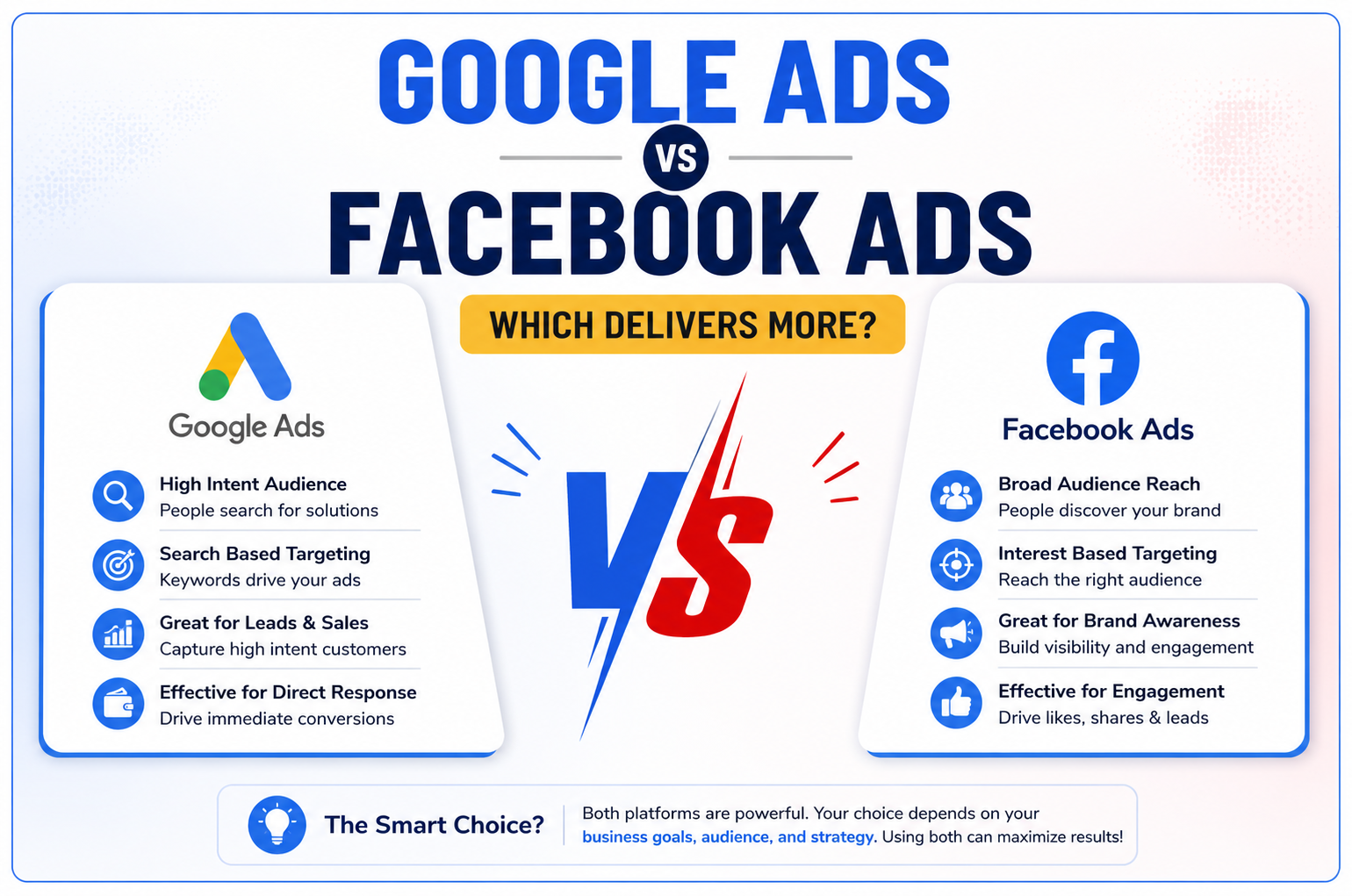
    Quick Takeaway: Google Ads helps you find new customers who are actively searching for your product or service with high intent. Facebook Ads helps new customers find you based on their interests, behaviors, and demographic profiles.

    What are Google Ads and How Do They Work?

    Google Ads is the world’s premier PPC advertising (Pay-Per-Click) platform. It operates primarily on the concept of search intent. When a user types a specific word or phrase into the Google search engine, they are actively looking for an answer, a location, or a product to buy. Google Ads allows businesses to bid on these specific keywords to display their sponsored links at the very top of the search engine results pages (SERPs).

    Beyond the core search network, the Google Ads benefits extend to the Google Display Network (visual banners on partner websites), YouTube advertising, Shopping ads, and local map listings. Because users are explicitly telling the search engine what they want at that exact millisecond, Google Ads boasts unparalleled immediate conversion potential.

    What are Facebook Ads and How Do They Work?

    While Google dominates search, Meta’s platform rules supreme over social media advertising. Facebook Ads is a paid social platform that operates on interruption marketing. Users do not log into Facebook or Instagram to find a plumber or buy software; they log in to connect with friends, watch videos, and view curated content.

    The immense power and core Facebook Ads benefits lie in its unparalleled demographic and behavioral targeting. Facebook tracks user interests, historical behaviors, life events (like engagements or moving cities), and digital habits. This allows advertisers to build highly detailed audience personas and display visually compelling ads directly within a user’s organic social feed, capturing interest long before a consumer even knows they need a specific solution.

    Google Ads vs Facebook Ads: Head-to-Head Comparison

    To truly evaluate Google Ads vs Facebook Ads for small business and enterprise scales alike, we must examine how they handle critical advertising metrics.

    1. Audience Intent

    Google wins on intent. Users have an active, immediate need (e.g., “emergency AC repair near me”). Facebook relies on passive intent; you are introducing your brand to a user who fits your ideal client profile but might not be ready to purchase today.

    2. Targeting Capabilities

    Google targets keywords and phrases, alongside physical locations and search history. Facebook targets people and identities, offering granular choices regarding hobbies, relationships, job titles, and lookalike audiences who mimic your best existing buyers.

    3. Facebook Ads vs Google Ads Cost (CPC)

    When looking closely at the Facebook Ads vs Google Ads cost breakdown, Facebook generally offers a significantly lower Cost Per Click (CPC). Google Ads keywords in competitive niches (like legal, insurance, or finance) can cost upwards of $50 per click due to high intent, whereas Facebook clicks frequently cost under $2.

    4. Conversion Rates

    Google Ads typically boasts a higher immediate conversion rate for transactional searches because the user is at the bottom of the sales funnel. Facebook conversion paths often take longer, requiring multiple touchpoints to convert a cold social browser into a verified client.

    5. Lead Generation & Brand Awareness

    Google is excellent for capture-oriented lead generation. However, Facebook is an absolute powerhouse for cost-effective mass brand awareness and top-of-funnel lead generation through native Lead Forms that don’t require the user to leave the social application.

    6. Retargeting & Ad Formats

    Both platforms excel at retargeting, but Facebook allows for more visually immersive ad formats. From engaging video stories and carousels to dynamic catalog layouts, Facebook brings aesthetic advantages, whereas Google relies more heavily on text-based layouts and standard display banners.

    7. ROI Potential

    Google provides quick, linear Return on Investment (ROI) for immediate sales. Facebook provides compounding long-term ROI by building a loyal community, generating brand equity, and nurturing custom audiences over time.

    Feature / Metric Google Ads Facebook Ads
    Core Focus Paid Search (Demand Capture) Paid Social (Demand Generation)
    User Intent High (Active Searchers) Low-Medium (Passive Browsers)
    Average CPC Higher (Dependent on keyword competition) Lower (More affordable per click)
    Targeting Base Keywords, Intent, Location Demographics, Interests, Behaviors
    Primary Ad Formats Text Ads, Shopping Tiles, YouTube Video Image, Video, Carousel, Stories
    Best For Immediate sales, urgent service requests Brand discovery, visual lifestyle goods

    When Should Your Business Choose Google Ads?

    Google Ads is your absolute best choice under the following conditions:

    • Urgent or Immediate Need: If you run a business that people require in an emergency situation (e.g., locksmiths, plumbers, tow trucks), nobody browses Facebook for help. They open Google.
    • High-Value B2B Software/Services: When buyers are seeking enterprise-grade ERP tools or specialized consultancies, they perform active, rigorous search research.
    • Healthy Marketing Budgets: If you can afford a higher CPC to guarantee your placement at the exact moment a buyer has their credit card in hand.

    When Should Your Business Choose Facebook Ads?

    Conversely, Facebook Ads should take strategic priority when:

    • Visually Dynamic or Unique Products: If your product relies heavily on aesthetics, apparel design, fitness transformations, or innovative gadgets that require video demonstrations to explain.
    • Building an Audience from Scratch: If you are introducing a brand-new concept or sub-category that has zero existing search volume on search engines.
    • Strict Budgetary Constraints: If you are a small business looking to maximize your visual reach and get thousands of digital impressions for a modest daily spend.

    The Ultimate Strategy: Combining Platforms for Maximum Growth

    The reality of the modern digital advertising comparison is that it shouldn’t be an “either/or” question. For the vast majority of growing brands, utilizing both networks simultaneously yields the highest return on ad spend (ROAS).

    Consider this powerful omni-channel ecosystem: You use Google Ads to capture high-intent search traffic from customers ready to buy immediately. Concurrently, you deploy Facebook Ads to target those exact website visitors who left without completing a purchase via sophisticated cross-channel retargeting campaigns. By keeping your brand visible on both their search engines and social feeds, you construct an omniscient digital presence that systematically converts cold traffic.

    Real-World Practical Scenarios

    1. Local Businesses (e.g., Local Dental Clinic):

    Use Google Ads for high-intent keywords like “dentist near me” or “teeth whitening clinic.” Use Facebook Ads locally to promote a friendly video tour, student discounts, or community milestones to build familiarity.

    2. E-commerce Stores (e.g., Sustainable Apparel Brand):

    Prioritize Facebook and Instagram Ads with rich video carousels showing real people wearing the clothing. Use Google Shopping Ads to catch users who search specifically for “organic cotton hoodies.”

    3. Service-Based Businesses (e.g., Residential Roofing):

    Rely heavily on Google Ads during stormy seasons when roofs need emergency repairs. Use Facebook Ads after a storm to showcase “before and after” pictures to specific neighborhoods.

    4. B2B Companies (e.g., HR Payroll Software):

    Bid on intent keywords like “automated payroll software for startups” on Google. Concurrently, use Facebook/Instagram Ads targeted at founders and HR managers offering a free whitepaper download.

    Expert Tips to Maximize Performance

    • For Google Ads: Always build out a robust list of negative keywords. This prevents your ad from showing up for irrelevant searches (e.g., ensuring your ad for “paid premium courses” doesn’t display when someone searches “free courses”).
    • For Facebook Ads: Prioritize creative testing. Swap out video hooks, thumbnails, and copy variations weekly to prevent ad fatigue within your target demographics.

    Common Mistakes to Avoid

    Many business owners burning through their budgets fall prey to simple structural mistakes. On Google Ads, using exclusively broad-match keywords can result in massive wasted spend on unrelated queries. On Facebook Ads, the most frequent error is over-segmenting audiences into tiny pools, which restricts Meta’s machine learning delivery system from optimizing properly. Lastly, failing to set up accurate conversion tracking pixels ensures you remain completely blind to your actual acquisition costs.

    Frequently Asked Questions (FAQ)

    Q1: Is Google Ads or Facebook Ads better for a small business with a tight budget?

    A: Facebook Ads usually offers a lower barrier to entry due to its cheaper average cost-per-click. However, if your small business addresses urgent services (like auto towing or locksmiths), Google Search remains critical despite higher costs.

    Q2: Can I handle both Google and Facebook advertising completely on my own?

    A: While the platforms are accessible, managing complex keyword bidding, negative matches, tracking pixels, and routine creative rotation requires specialized daily attention. Partnering with a digital agency usually saves money long-term by eliminating wasted ad spend.

    Q3: How much money do I need to start testing Google Ads?

    A: It varies by industry keyword costs, but we generally recommend a starting budget of at least $30 to $50 per day to accumulate enough data within a month to optimize effectively.

    Q4: What is a typical conversion rate for Facebook social media advertising?

    A: Across industries, the average conversion rate on Facebook sits around 1% to 3%. However, highly optimized retargeting campaigns and compelling visual offers can push this metric significantly higher.

    Q5: Do Facebook Ads affect my website’s organic SEO rankings?

    A: No, paid ads on Facebook or Google do not directly impact your organic search engine rankings. However, the increased traffic, brand searches, and social sharing can indirectly signal brand authority to major search networks.

    Ready to Maximize Your Return on Ad Spend?

    Settling the debate between Google Ads vs Facebook Ads comes down to aligned strategy, creative optimization, and expert analytical oversight. Don’t leave your advertising budgets to guesswork and algorithmic defaults.

    Contact our dedicated digital marketing agency team today for a customized paid advertising consultation!

    Scale Your Campaigns Today


  • Social Media Marketing Trends 2026 for Business Growth

    Social Media Marketing Trends 2026 for Business Growth

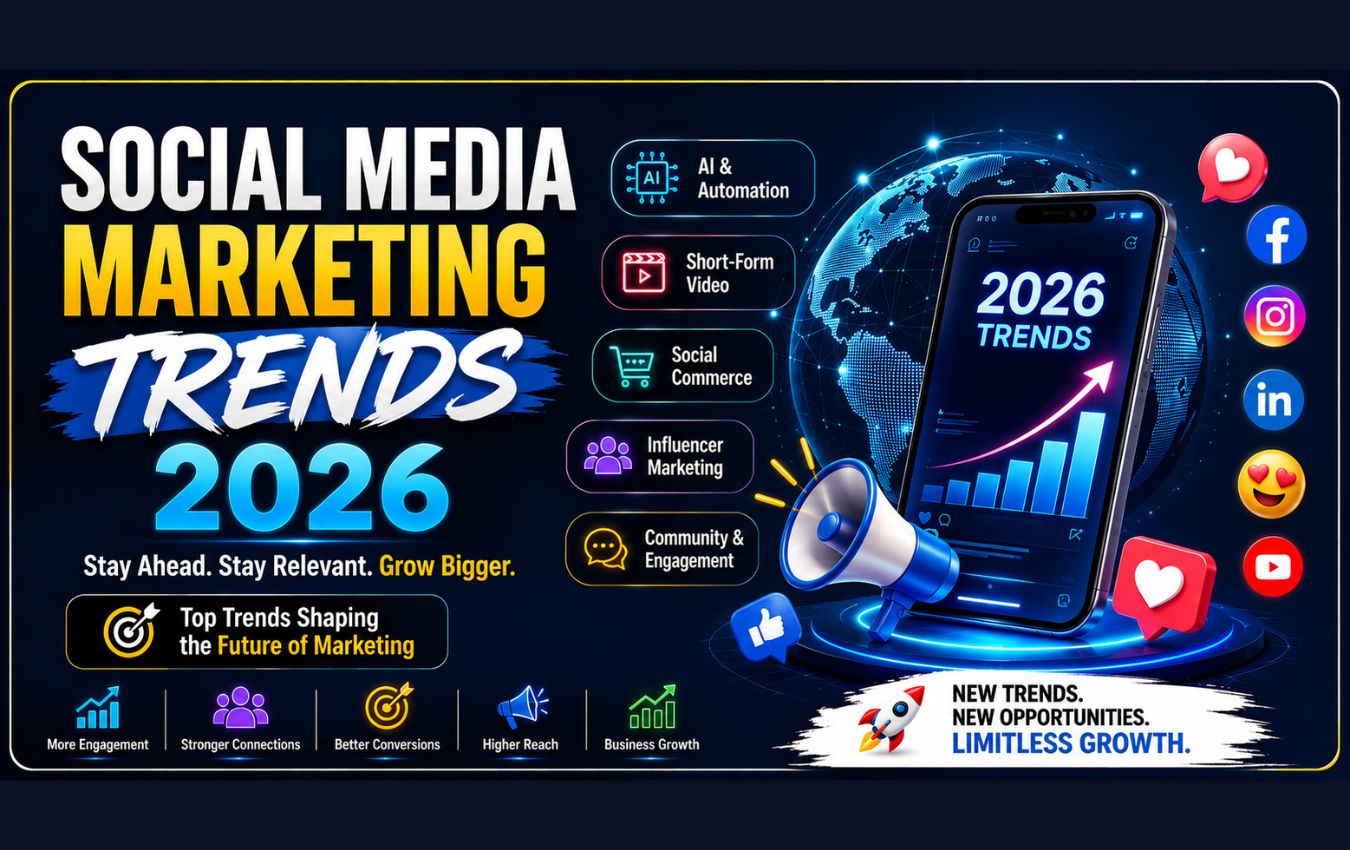
    Social Media Marketing Trends 2026: What Businesses Need to Know

    A Definitive Guide to Navigating the Future of Social Media Marketing

    The digital space is shifting rapidly. In 2026, social networks are no longer just for basic updates or generic ads—they are ecosystems driven by hyper-personalization, intelligent automation, and frictionless commerce. For brands aiming to catch the eyes of consumers, old playbooks fail. Success requires proactive adaptation to modern consumer touchpoints.

    To build a thriving social media strategy 2026, companies must look at how technology changes buyer habits. This year, the forces shaping the market are rooted in sophisticated AI in social media marketing, automated workflows, and fast video formats. Adapting early separates market leaders from brands that fade away into obscurity.

    Key Industry Insight

    By mid-2026, active social networks are projected to reach 5.4 billion global users. Over 65% of buyers state that their commercial choices are directly influenced by native social shops and automated messaging tools.

    Why Social Media Marketing Matters More Than Ever in 2026

    Active user numbers have hit historic highs across channels, introducing extreme market saturation. Consumers face constant message bombardment, leading to high ad fatigue and short attention spans. Standard advertising setups struggle to yield acceptable returns, forcing corporations to rethink outreach.

    Securing consumer engagement and long-term brand awareness demands absolute precision. Social feeds are where initial brand sentiment forms and thrives. Businesses leveraging forward-looking digital marketing trends 2026 can build deeper consumer relationships, ensuring reliable brand loyalty and growth in a crowded arena.

    Top Social Media Marketing Trends 2026

    AI-Powered Content Creation and Personalization

    Smart systems have moved beyond basic text drafting. Today, AI in social media marketing allows brands to analyze data metrics instantly to deliver customized graphics, contextual copy, and dynamic variations tailored to user profiles. Predictive analytics accurately forecast how specific groups respond to content assets.

    Short-Form Video Continues to Dominate

    As a central driver within video marketing trends 2026, short vertical clips—Reels, Shorts, and TikTok videos—remain the absolute kings of organic reach. Algorithm setups prioritize fast video narratives over text, generating up to 4x higher interaction rates across main demographics.

    • Hook users in the first 1.5 seconds using strong visual cues.
    • Focus heavily on educational insights or fast problem-solving value.
    • Value authenticity; raw, genuine footage outpaces overly polished corporate clips.

    Social Commerce Becomes Mainstream

    The friction between product discovery and checking out has vanished. Driven by explosive social commerce trends, networks have built complete native store engines. With embedded secure payment gateways, consumers buy products instantly without leaving their feeds.

    +38%
    Average conversion rate increase via integrated native checkouts versus external redirects.

    Influencer Marketing Evolves

    The era of shallow metric tracking is over. Recent influencer marketing trends show a major shift away from macro-celebrities toward micro and nano influencers with hyper-focused followings. Audiences demand real transparency, trusting relatable creators over generic celebrity endorsements.

    User-Generated Content Gains More Value

    User-Generated Content (UGC) acts as ultimate social proof. Buyers trust peer reviews and raw user testimonials far more than traditional ads. Showcasing real people interacting with your brand builds immediate credibility that corporate design cannot match.

    AI Chatbots and Conversational Marketing

    Fueled by major developments in social media automation, smart bots manage consumer inquiries with impressive fluidity. These tools offer immediate replies, answer catalog questions, provide product suggestions, and nurture new leads 24/7.

    Privacy-First Marketing Strategies

    Strict compliance rules and the complete removal of third-party tracking have altered social media advertising trends. Marketers can no longer rely on external cookie histories. Campaigns must shift toward building secure first-party data structures.

    Social Listening and Brand Monitoring

    Brand safety requires proactive monitoring rather than reactive responses. Implementing automated sentiment listening tools lets companies track active digital discussions, scan keyword mentions, and evaluate competitor metrics clearly to safeguard trust.

    Rise of Community-Based Marketing

    As public feeds become crowded, user interactions are shifting to private spaces. Closed groups, subscriber channels, and specialized forums are the new centers for community marketing, helping companies build high-value customer relationships.

    Cross-Platform Content Strategies

    Relying on a single network carries significant structural business risk. Sophisticated content strategies ensure maximum distribution by adapting a core creative asset into specific pieces built for separate channels and emerging social platforms.

    How Businesses Can Prepare for Social Media Marketing in 2026

    Winning in this changing environment requires active preparation. Brands must update workflows to build operational agility. Focus on these strategic pillars:

    • Invest in AI Tools: Adopt automated scheduling, smart content engines, and predictive analytics.
    • Prioritize Video Pipelines: Dedicate resources to scale continuous vertical clip production.
    • Build Private Communities: Create closed communication spaces to cultivate deep interactions.
    • Value Transparency: Swap rigid ads for open customer engagement and real conversations.
    • Track Metrics: Base all marketing adjustments on hard data and first-party conversion tracking.

    Benefits of Following the Latest Social Media Marketing Trends

    Syncing your brand’s digital strategies with current social media marketing trends 2026 converts social profiles into major corporate revenue drivers:

    • Increased Engagement: Delivers algorithmic preference, scaling organic impressions easily.
    • Better Lead Generation: Attracts qualified prospects using targeted dynamic assets.
    • Higher Conversions: Streamlines sales via integrated, native in-app checkout networks.
    • Improved Brand Awareness: Establishes a clear presence within crowded industries.
    • Competitive Advantage: Keeps your organization ahead of slower, traditional competitors.

    Why Choose Professional Social Media Marketing Services?

    Managing a multi-channel presence demands deep technical platform knowledge. Collaborating with an expert agency guarantees your corporate strategy stays updated against sudden algorithm adjustments to sustain long-term business growth.

    A dedicated digital agency handles your entire social footprint across crucial execution pillars:

    • Expert Strategy Development: Building customized blueprints mapped to your business targets.
    • Content Creation: Generating high-impact short videos, graphic layouts, and persuasive ad copy.
    • Paid Advertising Campaigns: Deploying optimized media spend using custom audience segments.
    • Analytics and Reporting: Offering clear conversion clarity to ensure long-term business growth.

    Frequently Asked Questions (FAQ)

    What are the biggest social media marketing trends in 2026?

    The dominant pillars of social media marketing trends 2026 include AI content personalization, native app social commerce, authentic micro-influencer campaigns, and first-party data community models.

    How is AI changing social media marketing?

    AI in social media marketing automates real-time asset variation creation, manages conversational customer care through chatbots, and processes predictive audience analytics to maximize targeting accuracy.

    Why is short-form video important in 2026?

    Short vertical clips dominate the future of social media marketing. Algorithms favor these interactive pieces, providing brands with superior organic reach and higher viewer connection metrics.

    What is social commerce?

    Modern social commerce trends represent the complete integration of digital checkout paths directly into social networks, enabling users to purchase items natively without leaving the app.

    How can businesses improve their social media strategy?

    Organizations can optimize their social media strategy 2026 by embedding responsive automation, ramping up vertical video clip pipelines, and cultivating transparent private brand communities.

    Ready to Upgrade Your Strategy for 2026?

    Don’t let your brand get left behind by fast-evolving algorithms. Contact our professional Social Media Marketing Agency today to launch a custom strategy engineered for customer acquisition, ad efficiency, and long-term business growth.

    Contact Our Experts Today