Google Ads vs Facebook Ads: Which is Best for Your Business in 2026?
For any business looking to accelerate its growth, navigating the complex world of digital advertising comparison tools can feel overwhelming. When deciding where to allocate your hard-earned marketing budget, the debate almost always centers around one critical matchup: Google Ads vs Facebook Ads. Both represent the absolute pinnacles of modern online advertising platforms, yet they operate on entirely different methodologies and capture users at distinct stages of the buying journey.
Choosing between Google Ads or Facebook Ads is not merely about picking the cheaper platform; it is about understanding how your specific target market consumes information and makes purchasing decisions. In this comprehensive guide, we will break down the mechanics, costs, and strategic advantages of both networks to help you determine the optimal blueprint for your business growth.
What are Google Ads and How Do They Work?
Google Ads is the world’s premier PPC advertising (Pay-Per-Click) platform. It operates primarily on the concept of search intent. When a user types a specific word or phrase into the Google search engine, they are actively looking for an answer, a location, or a product to buy. Google Ads allows businesses to bid on these specific keywords to display their sponsored links at the very top of the search engine results pages (SERPs).
Beyond the core search network, the Google Ads benefits extend to the Google Display Network (visual banners on partner websites), YouTube advertising, Shopping ads, and local map listings. Because users are explicitly telling the search engine what they want at that exact millisecond, Google Ads boasts unparalleled immediate conversion potential.
What are Facebook Ads and How Do They Work?
While Google dominates search, Meta’s platform rules supreme over social media advertising. Facebook Ads is a paid social platform that operates on interruption marketing. Users do not log into Facebook or Instagram to find a plumber or buy software; they log in to connect with friends, watch videos, and view curated content.
The immense power and core Facebook Ads benefits lie in its unparalleled demographic and behavioral targeting. Facebook tracks user interests, historical behaviors, life events (like engagements or moving cities), and digital habits. This allows advertisers to build highly detailed audience personas and display visually compelling ads directly within a user’s organic social feed, capturing interest long before a consumer even knows they need a specific solution.
Google Ads vs Facebook Ads: Head-to-Head Comparison
To truly evaluate Google Ads vs Facebook Ads for small business and enterprise scales alike, we must examine how they handle critical advertising metrics.
1. Audience Intent
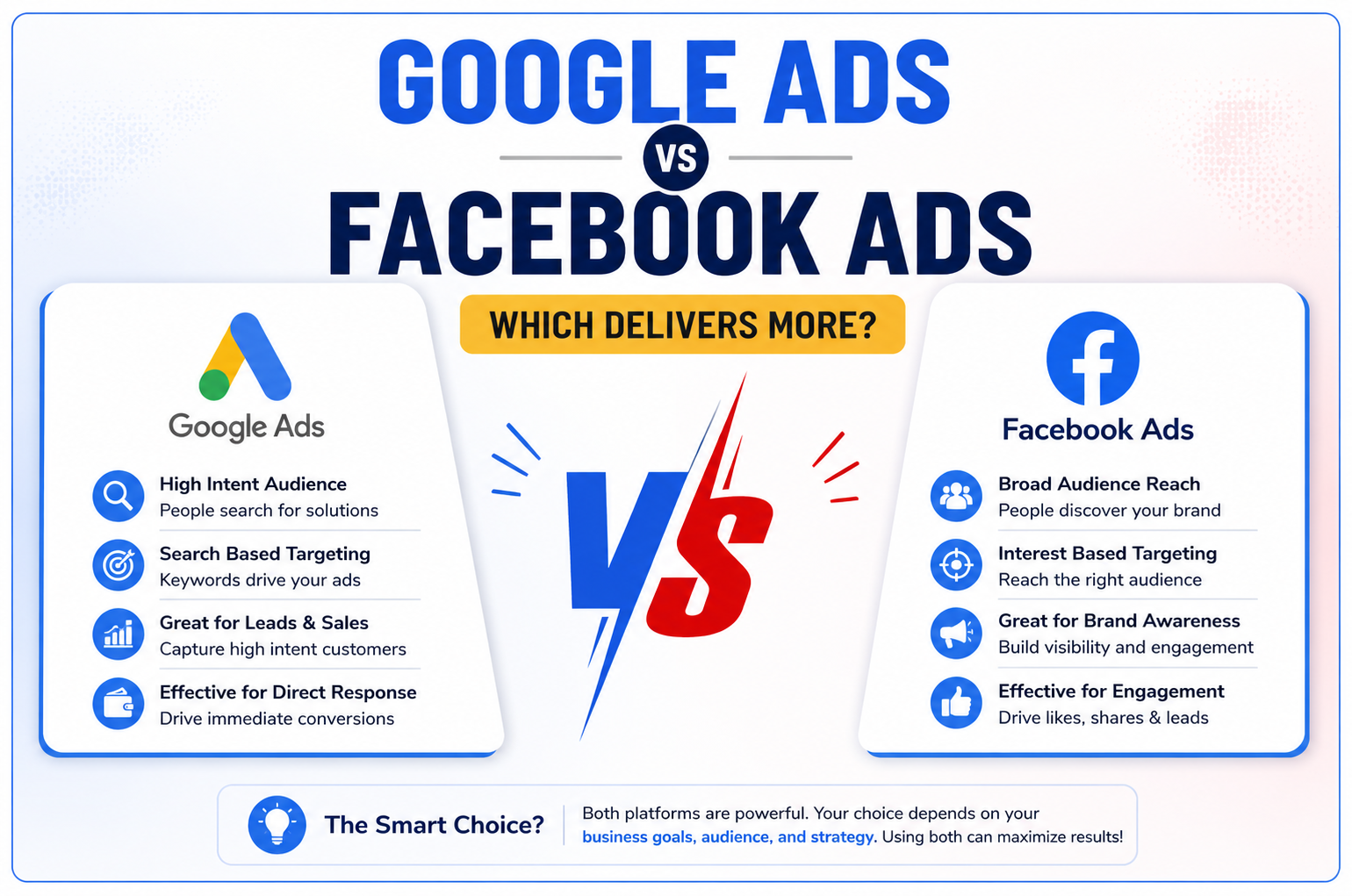
Google wins on intent. Users have an active, immediate need (e.g., “emergency AC repair near me”). Facebook relies on passive intent; you are introducing your brand to a user who fits your ideal client profile but might not be ready to purchase today.
2. Targeting Capabilities
Google targets keywords and phrases, alongside physical locations and search history. Facebook targets people and identities, offering granular choices regarding hobbies, relationships, job titles, and lookalike audiences who mimic your best existing buyers.
3. Facebook Ads vs Google Ads Cost (CPC)
When looking closely at the Facebook Ads vs Google Ads cost breakdown, Facebook generally offers a significantly lower Cost Per Click (CPC). Google Ads keywords in competitive niches (like legal, insurance, or finance) can cost upwards of $50 per click due to high intent, whereas Facebook clicks frequently cost under $2.
4. Conversion Rates
Google Ads typically boasts a higher immediate conversion rate for transactional searches because the user is at the bottom of the sales funnel. Facebook conversion paths often take longer, requiring multiple touchpoints to convert a cold social browser into a verified client.
5. Lead Generation & Brand Awareness
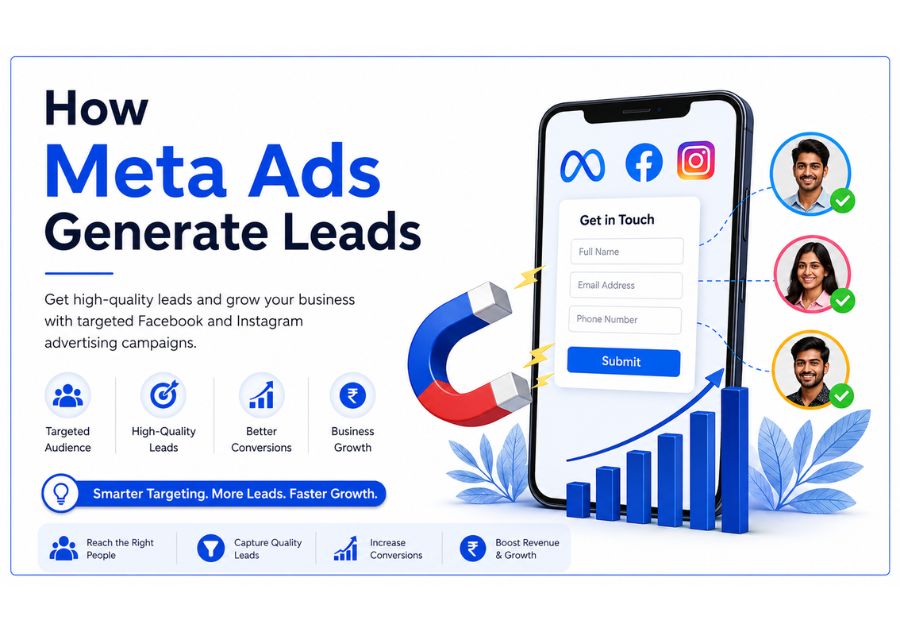
Google is excellent for capture-oriented lead generation. However, Facebook is an absolute powerhouse for cost-effective mass brand awareness and top-of-funnel lead generation through native Lead Forms that don’t require the user to leave the social application.
6. Retargeting & Ad Formats
Both platforms excel at retargeting, but Facebook allows for more visually immersive ad formats. From engaging video stories and carousels to dynamic catalog layouts, Facebook brings aesthetic advantages, whereas Google relies more heavily on text-based layouts and standard display banners.
7. ROI Potential
Google provides quick, linear Return on Investment (ROI) for immediate sales. Facebook provides compounding long-term ROI by building a loyal community, generating brand equity, and nurturing custom audiences over time.
| Feature / Metric | Google Ads | Facebook Ads |
|---|---|---|
| Core Focus | Paid Search (Demand Capture) | Paid Social (Demand Generation) |
| User Intent | High (Active Searchers) | Low-Medium (Passive Browsers) |
| Average CPC | Higher (Dependent on keyword competition) | Lower (More affordable per click) |
| Targeting Base | Keywords, Intent, Location | Demographics, Interests, Behaviors |
| Primary Ad Formats | Text Ads, Shopping Tiles, YouTube Video | Image, Video, Carousel, Stories |
| Best For | Immediate sales, urgent service requests | Brand discovery, visual lifestyle goods |
When Should Your Business Choose Google Ads?
Google Ads is your absolute best choice under the following conditions:
- Urgent or Immediate Need: If you run a business that people require in an emergency situation (e.g., locksmiths, plumbers, tow trucks), nobody browses Facebook for help. They open Google.
- High-Value B2B Software/Services: When buyers are seeking enterprise-grade ERP tools or specialized consultancies, they perform active, rigorous search research.
- Healthy Marketing Budgets: If you can afford a higher CPC to guarantee your placement at the exact moment a buyer has their credit card in hand.
When Should Your Business Choose Facebook Ads?
Conversely, Facebook Ads should take strategic priority when:
- Visually Dynamic or Unique Products: If your product relies heavily on aesthetics, apparel design, fitness transformations, or innovative gadgets that require video demonstrations to explain.
- Building an Audience from Scratch: If you are introducing a brand-new concept or sub-category that has zero existing search volume on search engines.
- Strict Budgetary Constraints: If you are a small business looking to maximize your visual reach and get thousands of digital impressions for a modest daily spend.
The Ultimate Strategy: Combining Platforms for Maximum Growth
The reality of the modern digital advertising comparison is that it shouldn’t be an “either/or” question. For the vast majority of growing brands, utilizing both networks simultaneously yields the highest return on ad spend (ROAS).
Consider this powerful omni-channel ecosystem: You use Google Ads to capture high-intent search traffic from customers ready to buy immediately. Concurrently, you deploy Facebook Ads to target those exact website visitors who left without completing a purchase via sophisticated cross-channel retargeting campaigns. By keeping your brand visible on both their search engines and social feeds, you construct an omniscient digital presence that systematically converts cold traffic.
Real-World Practical Scenarios
1. Local Businesses (e.g., Local Dental Clinic):
Use Google Ads for high-intent keywords like “dentist near me” or “teeth whitening clinic.” Use Facebook Ads locally to promote a friendly video tour, student discounts, or community milestones to build familiarity.
2. E-commerce Stores (e.g., Sustainable Apparel Brand):
Prioritize Facebook and Instagram Ads with rich video carousels showing real people wearing the clothing. Use Google Shopping Ads to catch users who search specifically for “organic cotton hoodies.”
3. Service-Based Businesses (e.g., Residential Roofing):
Rely heavily on Google Ads during stormy seasons when roofs need emergency repairs. Use Facebook Ads after a storm to showcase “before and after” pictures to specific neighborhoods.
4. B2B Companies (e.g., HR Payroll Software):
Bid on intent keywords like “automated payroll software for startups” on Google. Concurrently, use Facebook/Instagram Ads targeted at founders and HR managers offering a free whitepaper download.
Expert Tips to Maximize Performance
- For Google Ads: Always build out a robust list of negative keywords. This prevents your ad from showing up for irrelevant searches (e.g., ensuring your ad for “paid premium courses” doesn’t display when someone searches “free courses”).
- For Facebook Ads: Prioritize creative testing. Swap out video hooks, thumbnails, and copy variations weekly to prevent ad fatigue within your target demographics.
Common Mistakes to Avoid
Many business owners burning through their budgets fall prey to simple structural mistakes. On Google Ads, using exclusively broad-match keywords can result in massive wasted spend on unrelated queries. On Facebook Ads, the most frequent error is over-segmenting audiences into tiny pools, which restricts Meta’s machine learning delivery system from optimizing properly. Lastly, failing to set up accurate conversion tracking pixels ensures you remain completely blind to your actual acquisition costs.
Frequently Asked Questions (FAQ)
Q1: Is Google Ads or Facebook Ads better for a small business with a tight budget?
A: Facebook Ads usually offers a lower barrier to entry due to its cheaper average cost-per-click. However, if your small business addresses urgent services (like auto towing or locksmiths), Google Search remains critical despite higher costs.
Q2: Can I handle both Google and Facebook advertising completely on my own?
A: While the platforms are accessible, managing complex keyword bidding, negative matches, tracking pixels, and routine creative rotation requires specialized daily attention. Partnering with a digital agency usually saves money long-term by eliminating wasted ad spend.
Q3: How much money do I need to start testing Google Ads?
A: It varies by industry keyword costs, but we generally recommend a starting budget of at least $30 to $50 per day to accumulate enough data within a month to optimize effectively.
Q4: What is a typical conversion rate for Facebook social media advertising?
A: Across industries, the average conversion rate on Facebook sits around 1% to 3%. However, highly optimized retargeting campaigns and compelling visual offers can push this metric significantly higher.
Q5: Do Facebook Ads affect my website’s organic SEO rankings?
A: No, paid ads on Facebook or Google do not directly impact your organic search engine rankings. However, the increased traffic, brand searches, and social sharing can indirectly signal brand authority to major search networks.
Ready to Maximize Your Return on Ad Spend?
Settling the debate between Google Ads vs Facebook Ads comes down to aligned strategy, creative optimization, and expert analytical oversight. Don’t leave your advertising budgets to guesswork and algorithmic defaults.
Contact our dedicated digital marketing agency team today for a customized paid advertising consultation!