How Meta Ads Generate Leads: The Ultimate Guide for High-Converting Campaigns
Published on: June 15, 2026 | Category: Paid Social Media Marketing
In today’s highly competitive digital landscape, capturing the attention of your target audience is only half the battle. The real challenge lies in turning that fleeting attention into structured, high-intent inquiries. If you have been wondering precisely how Meta Ads generate leads for businesses, you are not alone.
With over 3 billion active daily users across Facebook, Instagram, Messenger, and the Audience Network, Meta provides an unparalleled ecosystem for B2B and B2C brands alike. By leveraging advanced machine learning algorithms, deep demographic mapping, and native conversion pathways, modern social media lead generation has transformed from a guessing game into a predictable, scalable science. This comprehensive guide breaks down exactly how to harness Meta’s full suite of tools to consistently fuel your sales funnel.
What Are Meta Ads?
Meta Ads refers to the comprehensive, centralized advertising network encompassing Facebook, Instagram, Messenger, and thousands of partner mobile applications. Managed entirely through the Meta Business Suite and Ads Manager, this environment allows enterprises to run highly targeted image, video, carousel, and collection advertisements.
Rather than treating these platforms purely as social playgrounds, experienced marketers view them as data-driven engines built to address every stage of the marketing funnel. Whether your goal is brand awareness or direct-response customer acquisition, Meta’s infrastructure processes billions of behavioral signals to display your message to the exact individuals most likely to engage with your brand.
Why Businesses Use Meta Ads for Lead Generation
Deploying Facebook advertising for businesses is no longer optional for organizations aiming to maintain market relevance. Organizations globally prioritize Meta for customer acquisition due to three core structural advantages:
- Granular Audience Precision: Beyond basic age and geographic parameters, Meta tracks granular behavioral patterns, detailed professional titles, purchasing habits, and core psychographic interests.
- Algorithmic Efficiency: Meta’s predictive AI analyzes which users historically convert on lead forms, continuously optimizing ad delivery to minimize your cost per lead (CPL).
- Frictionless User Experiences: By removing the necessity for users to navigate away from their active feeds, Meta minimizes drop-off rates and maximizes form completion velocity.
How Meta Ads Generate High-Quality Leads
A common misconception is that social platforms only drive volume, not value. In reality, understanding how Meta Ads generate leads that actually convert requires analyzing the multi-tiered conversion funnel engineered by Meta’s ecosystem.
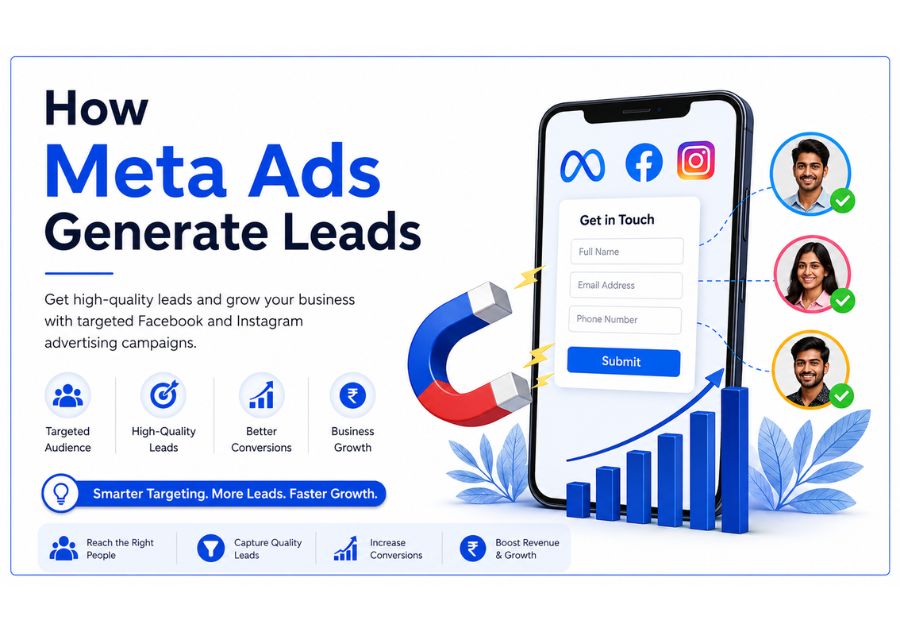
The process begins with precise targeting via Lookalike Audiences (LAL) and Custom Audiences built from your existing CRM data. When a high-intent user interacts with your compelling ad creative, Meta utilizes interactive, auto-populated forms. Because these forms instantly ingest verified contact data from the user’s personal profile (such as their primary email address and phone number), structural errors and fake credentials are systematically reduced.
Real-World Enterprise Example:
A mid-sized B2B software provider utilized Custom Audiences to target decision-makers who visited their pricing page but didn’t book a demo. By launching targeted Facebook Lead Ads paired with an exclusive whitepaper download, they generated 450+ qualified enterprise leads in 30 days, reducing their target cost-per-acquisition (CPA) by 34%.
Types of Meta Lead Generation Campaigns
When setting up your lead generation campaigns, Meta allows you to select from several distinct operational mechanisms depending on your backend CRM layout:
- Instant Forms (Native Lead Ads): Contextual forms that load instantly inside the application. Best for high-volume conversion.
- Messenger & Automated Chats: Initiates an interactive, AI-driven conversation to pre-qualify prospects through custom question sequences before routing them to human sales professionals.
- Instagram Direct Messages (DMs): Capitalizes on Instagram Lead Ads to drive users directly into conversational commerce flows via direct messaging.
- External Web Conversions: Directs targeted traffic to dedicated external landing pages optimized via the Meta Pixel and Conversions API (CAPI).
Facebook Lead Ads vs Landing Page Ads
Choosing between native instant forms and external website architectures drastically impacts your conversion metrics. Below is an analytical comparison designed to guide your strategic framework:
| Feature / Metric | Native Facebook Lead Ads | External Landing Page Ads |
|---|---|---|
| User Friction | Extremely Low (Auto-populated fields) | Higher (Requires external page load) |
| Average Lead Volume | High Volume | Moderate Volume |
| Lead Intent & Quality | Variable (Requires custom qualification) | Consistently High (Deep commitment) |
| Tracking Requirements | Zero setup (Native tracking) | Complex (Meta Pixel + Conversions API) |
Benefits of Meta Ads for Businesses
Investing your capital into structured paid social media marketing platforms delivers multi-layered institutional advantages:
- Seamless CRM Synchronization: Instantly stream your incoming leads to platforms like HubSpot, Salesforce, or Zapier for immediate outreach.
- Cost Optimization: Scale budgets fluidly, allocating capital dynamically toward ad sets delivering the lowest historical CPL.
- Cross-Platform Distribution: Effortlessly run identical high-performing visual assets across both Facebook and Instagram feeds via unified campaigns.
Best Practices for Generating More Leads with Meta Ads
To maximize your return on ad spend (ROAS), build your lead generation strategies around these verified execution frameworks:
1. Lead with Irresistible Lead Magnets
Stop asking for personal details without offering equal value. Provide exclusive whitepapers, localized case studies, free tool trials, or customized corporate audits.
2. Implement Intent Filters within Native Forms
When utilizing Instant Forms, toggle the “Higher Intent” option. This injects a confirmation step, giving users an explicit opportunity to review their information before submission.
3. Blend Custom Broad Questions
Incorporate at least two customized multiple-choice or short-answer questions. This disrupts automatic scrolling and filters out unmotivated individuals.
Common Mistakes to Avoid
Even robust marketing budgets can fail without precise execution. Avoid these catastrophic pitfalls:
- Over-complicating the Lead Form: Every additional custom field requested reduces your conversion probability by up to 15%. Keep inputs minimal.
- Ignoring Immediate Follow-ups: Conversion rates drop significantly if inbound leads aren’t contacted within the first five minutes of form submission.
- Failing to Exclude Past Converts: Always apply exclusion filters to prevent spending ad budget on users who have already entered your sales pipeline.
How to Measure Meta Ads Lead Generation Success
True campaign health goes far beyond vanity metrics like post engagement or clicks. Professional performance marketers evaluate performance using these strict parameters:
- Cost Per Lead (CPL): Total ad spend divided by total validated leads acquired.
- Lead-to-Opportunity Conversion Rate: The percentage of inbound leads that satisfy pipeline sales qualification criteria.
- Form Completion Rate: The proportion of platform users who initiated a form click and completed the conversion sequence.
The Future of AI-Powered Lead Generation
As data privacy regulations tighten, the future of marketing relies heavily on artificial intelligence. Meta’s **Advantage+ Lead Campaigns** represent this paradigm shift. By giving Meta’s core AI baseline parameters, the algorithm autonomously tests thousands of copy variations, visual placements, and audience matches. Embracing these machine-learning architectures is critical for businesses looking to scale acquisition efficiency.
Conclusion
Understanding exactly how Meta Ads generate leads unlocks a predictable mechanism for scaling customer acquisition. By matching compelling creatives, frictionless native instant forms, and advanced Advantage+ target parameters, Meta remains an unmatched powerhouse for B2B and B2C lead generation. Stop guessing and start building a systematic funnel that turns casual social media scrolling into revenue.
Ready to Scale Your Inbound Pipeline?
Don’t waste valuable capital on unoptimized campaigns. Partner with our premier meta advertising services team to engineer high-converting campaigns that drive authentic business growth. Maximize your ROAS today.
Frequently Asked Questions
How do Meta Ads generate leads?
Meta Ads generate leads by displaying highly targeted creative elements to precise audience groups. Users can submit their verified contact details instantly via native, auto-populated forms or optimized external landing pages.
Are Meta Ads effective for small businesses?
Yes, exceptionally so. Thanks to budget fluidity, small businesses can begin with modest daily budgets, validate target audiences, and scale investment entirely based on measurable cost-per-lead (CPL) success.
What is the difference between Facebook Lead Ads and website conversion ads?
Facebook Lead Ads keep users entirely within the native platform app utilizing fast, pre-filled forms. Website conversion ads drive the targeted prospect out to an external landing page hosted on your domain.
How much does Meta lead generation cost?
Costs vary widely depending on market competition, target industry vertical, and geography. While B2C sectors frequently experience CPLs between $2 to $10, competitive enterprise B2B spaces often range from $30 to $100+ per lead.
How can I improve lead quality from Meta Ads?
To elevate lead intent, use “Higher Intent” native configurations, inject custom open-ended questions, offer high-value programmatic lead magnets, and continuously refine targeting exclusions using active CRM data.