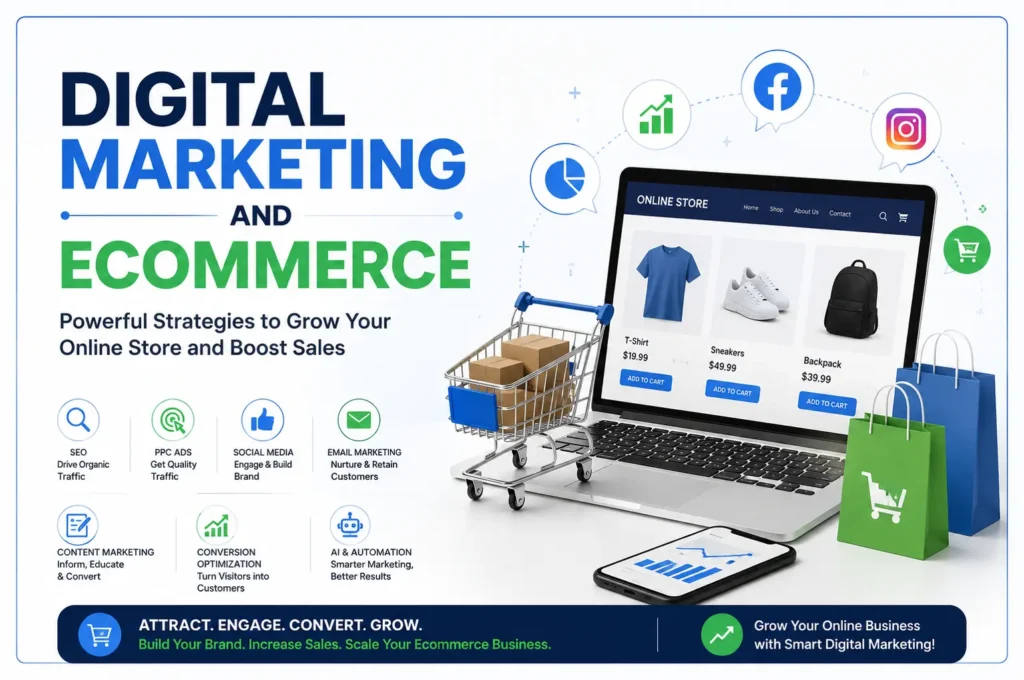
Digital Marketing and Ecommerce: A Complete Guide to Growing Your Online Store
Discover proven ecommerce digital marketing strategies to attract high-intent shoppers, increase conversions, and maximize customer lifetime value.
In today’s hyper-connected digital economy, digital marketing and ecommerce are fundamentally linked[cite: 1]. Building an aesthetically pleasing online storefront with high-quality products is only the first step toward long-term business success[cite: 1]. Without a strategic marketing engine driving high-intent buyers to your catalog, even the most innovative products will remain undiscovered in a crowded digital landscape[cite: 1].
At its core, ecommerce digital marketing acts as the bridge connecting consumer demand with your digital storefront[cite: 1]. From personalized email automation to high-converting social campaigns, executing effective digital marketing for online stores turns initial brand interest into measurable, repeatable revenue—converting one-time browsers into loyal brand advocates[cite: 1].
Why Digital Marketing is Essential for Ecommerce Businesses in 2026
The retail ecosystem has fundamentally changed[cite: 1]. Today’s consumers interact across multiple digital touchpoints before committing to a purchase[cite: 1]. Standing out in 2026 requires more than basic ads—it demands an integrated, omnichannel presence[cite: 1].
Here is why robust ecommerce marketing strategies are essential for sustainable ecommerce business growth:
- Escalating Acquisition Costs: Customer Acquisition Costs (CAC) on paid platforms continue to rise, making multi-channel organic retention strategies essential for profitability[cite: 1].
- Changing Search & Shopping Habits: Shoppers now use social channels, visual search, and traditional search engines simultaneously during their buyer journey[cite: 1].
- Demand for Hyper-Personalization: Over 70% of shoppers expect tailored product suggestions and dynamic discounts in real time[cite: 1].
Major Digital Marketing Channels Used in Ecommerce
1. Search Engine Optimization (SEO)
Implementing technical and on-page SEO for ecommerce ensures your store ranks prominently when users search with high purchase intent[cite: 1]. Optimizing site architecture, category descriptions, and product rich snippets helps capture consistent organic traffic without continuous ad spend[cite: 1].
2. Pay-Per-Click Advertising (PPC)
Paid campaigns through Google Shopping, Performance Max, and Meta Ads deliver immediate sales velocity[cite: 1]. Highly targeted ecommerce advertising puts your inventory directly in front of audiences actively seeking specific items[cite: 1].
3. Social Media Marketing & Social Commerce
Social platforms like Instagram and Pinterest allow online stores to convert social discovery directly into sales through native social commerce features and interactive product tagging[cite: 1].
4. Email & SMS Marketing
Automated lifecycle flows—including welcome series, abandoned cart recovery, and post-purchase follow-ups—generate high-margin revenue from an owned subscriber list[cite: 1].
5. Content & Influencer Marketing
Publishing comprehensive buying guides and partnering with micro-influencers builds trust and creates valuable social proof that boosts site-wide conversion rates[cite: 1].
6. Video Marketing, CRO & AI Automation
Short-form product videos boost product page engagement, while Conversion Rate Optimization (CRO) eliminates friction at checkout[cite: 1]. Paired with AI-powered marketing automation, stores can trigger personalized offers based on real-time user behavior[cite: 1].
Digital Marketing Channels Comparison
| Marketing Channel | Primary Benefit | Implementation Speed | Expected ROI |
|---|---|---|---|
| Search Engine Optimization | Long-term sustainable organic traffic & high buying intent[cite: 1] | 3 to 6 Months[cite: 1] | High (Compounding)[cite: 1] |
| Pay-Per-Click Ads | Immediate targeted traffic and fast conversion velocity[cite: 1] | Immediate (1–3 Days)[cite: 1] | Medium to High[cite: 1] |
| Email & SMS Marketing | High customer retention and direct owned messaging[cite: 1] | Fast (1–2 Weeks)[cite: 1] | Very High[cite: 1] |
| Social & Influencer Marketing | Brand awareness, viral engagement, and social proof[cite: 1] | 2 to 4 Weeks[cite: 1] | Medium[cite: 1] |
Actionable Strategies & Common Pitfalls to Avoid
Tips for Accelerating Ecommerce Sales Growth
- Set up automated cart abandonment flows with dynamic product discounts[cite: 1].
- Optimize checkout pages for frictionless one-click payments (Apple Pay, Shop Pay, Google Pay)[cite: 1].
- Incorporate high-resolution product videos and customer reviews on primary landing pages[cite: 1].
Common Ecommerce Marketing Mistakes
- Ignoring mobile page performance and responsive layout optimization[cite: 1].
- Over-relying on paid ad acquisition without investing in owned email channels or SEO[cite: 1].
- Failing to collect verified customer reviews and post-purchase user feedback[cite: 1].
Measuring Ecommerce Marketing Success Using KPIs
Tracking the right Key Performance Indicators (KPIs) ensures your online store marketing investments yield sustainable profits:
- Customer Acquisition Cost (CAC): The total marketing spend needed to acquire a single paying customer[cite: 1].
- Customer Lifetime Value (CLV): The total cumulative net profit generated by a customer over their relationship with your store[cite: 1].
- Conversion Rate (CR): The percentage of website visitors who successfully complete a purchase[cite: 1].
- Return on Ad Spend (ROAS): Gross revenue generated directly per dollar invested in advertising[cite: 1].
Accelerate Your Digital Marketing and Ecommerce Growth Today
Building a dominant online store requires combining targeted customer acquisition with dynamic retention strategies[cite: 1]. Master digital marketing and ecommerce growth frameworks to build a market-leading enterprise[cite: 1].
Leave a Reply